
The Cry Of A Black Man
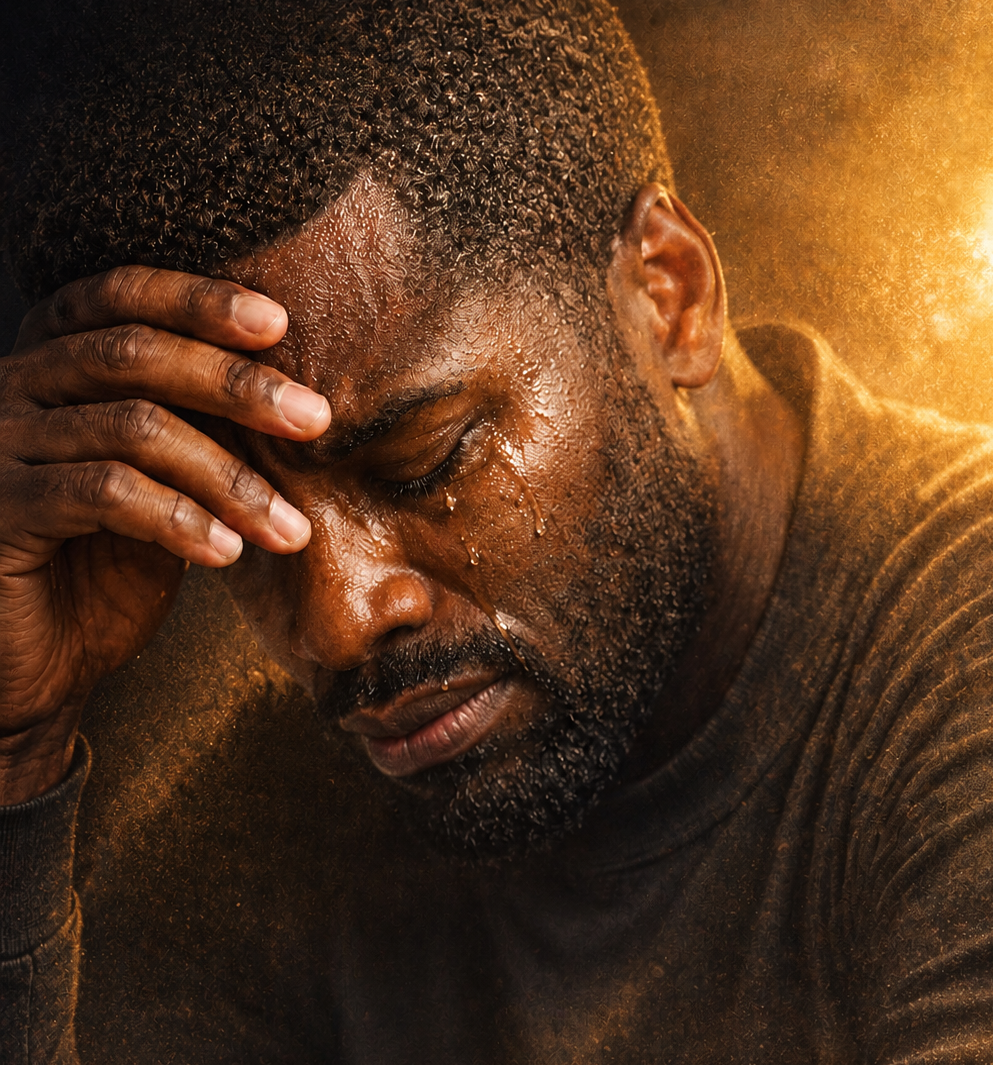
The Pain We Were Never Allowed To Express
The Pain We Were Never Allowed To Express
Have you ever considered questioning yourself: when was the last time I saw a Black man cry and, instead of telling him to ‘be strong,’ I simply listened?
We always do celebrate the strength of Black men, but rarely acknowledge the weight they always have to carry without complaining.
Behind closed doors, the smiles, the jokes, the hard work, and the silence are stories of grief, societal pressure, uncountable disappointments, bullying, sexual assault, and impending loneliness that often go unheard.
From very young ages, most Black boys are taught a quiet rule: ‘Don’t cry; don’t show weakness, because hey, you are a man, and a man is not supposed to cry!’
Read also Can’t Be an Option
As a result of that, most boys are abused socially, emotionally, physically, sexually, and in many other ways with no thought of complaining just because they have to prove they are ‘men,’ and hence they have to live by society’s ‘rules.’
But what happens when a man is never given a safe space to speak? What happens when every emotion is buried under the label of ‘be strong’?
At some point, strength without expression stops being strength; it becomes unbearable survival. And when survival is kept for too long, it begins to feel like isolation.
Many Black men don’t grow up learning how to express pain; they grow up learning how to contain it. In many homes and communities, strength is praised, but vulnerability is questioned.
A boy who cries is often told to “man up.” A young man who speaks about his emotions may be told he is weak, soft, or overreacting. Over time, these small messages build a quiet rule: feel it, but don’t show it.
So he learns to adapt; he learns to smile when he is tired. To stay silent even when it hurts so bad. To keep moving even when something inside him is breaking.
Several sociologists and physiologists argue that rigid social expectations of masculinity, such as the pressure to be a stoic “breadwinner” and suppress emotions, create immense psychological vulnerability.
Studies on this phenomenon note that these strict gender ‘rules’ lead to higher rates of suicide, isolation, and a reduced likelihood of seeking mental health support among men.
When pain is never expressed, it does not vanish; it transforms. It shows up as mental health struggles that go unnamed. It shows up in relationships that struggle to survive emotional distance.
It shows up in addiction or constant distraction. It shows up in isolation even when surrounded by people.
A black man’s silence is mostly mistaken for strength, but sometimes it is simply unbearable survival in disguise. And when survival has been stretched for too long, it becomes suffering.
However, there’s a way to find healing and redefine strength. Healing does not just arrive at perfection; it begins with permission.
Permission to speak, express, and feel and the permission to not be okay without any shame.
Men do not need to become ‘less strong’; rather, they need spaces where they can freely express themselves without any barriers of gender definition. Where speaking up is not seen as a failure but as courage.
This is not just an article. It is a deep reflection.
A reminder that behind closed doors there are many unheard stories of Black men waiting for a welcoming space to be heard.
“THE CRY OF A BLACK MAN” is not just about pain; it is about recognition. It is about creating a world
where emotional honesty is not rare but normal and accepted.
Where men are respected not only for what they endure but also supported for what they feel.
Because a man is not supposed to break before he is heard. And perhaps, just maybe, the real strength we have been praising all along is not silence but the courage to finally speak.
Writer
Bernard Obeng
Email: bernardobeng8002@gmail.com
Contact: +233539983670
About The Author